When powerful AI tools landed in everyone’s hands, there was a short window where they could have been used to do less.
That’s not what happened. The first reflex, almost universally, was more. More posts in the time it used to take to write one. More email, faster. More variations of the ad, the landing page, the cold message. People got handed something that could give them their afternoons back and immediately used it to manufacture more things that needed managing.
I did this too. For a few weeks I felt incredibly productive, in the way a slot machine feels rewarding. Then I noticed I was busier than before, the output was generic, and the time I’d supposedly saved had quietly been reinvested into producing more stuff I now had to maintain.
So I want to make a simple argument, against the current. The point of automation isn’t to produce more. It’s to need to produce less while keeping what matters. Used that way, AI is one of the best tools for a slower life that’s ever existed. Used the other way, it’s a machine for industrializing your own burnout.
Output was never the goal
It’s worth saying the obvious thing, because we forget it constantly: nobody actually wants output. Output is a means. What people want is the thing on the other side of it — money, sure, but really the freedom and time and ease that money was supposed to buy.
Hustle culture performs a quiet swap. It takes the means — work, output, hours — and promotes it to the goal. You stop asking whether the work is buying you the life and start measuring yourself by how much of it you’re doing. The dashboard becomes the point. The number going up is the reward.
AI accelerates this swap if you’re not careful, because it removes the natural friction that used to cap your output. Writing ten posts used to be hard, so you wrote one good one. Now ten is easy, so the temptation is to do ten mediocre ones and call it leverage.
Leverage toward what, though. That’s the question that breaks the spell.
“Slow productivity” is not slow work
The phrase isn’t mine. Cal Newport wrote a book with that title, and the idea has been floating around longer than that. But it gets misread constantly, so let me be precise about what I mean by it.
Slow productivity does not mean working slowly, or working less in some lazy sense, or romanticizing the artisan who takes three years to make a chair. It means doing fewer things, at a more natural pace, with the full quality your attention is capable of — and accepting that this often produces better results than frantic volume, even in pure business terms.
The “slow” is about the rhythm and the number of simultaneous commitments, not about effort. You can work intensely. You just don’t work on forty things at once, forever, while answering everything in real time.
AI fits this beautifully, but only if you point it in the right direction. The direction is subtraction.
Use AI to subtract, not to add
Here’s the reframe that changed how I work. Before automating anything, I stopped asking “what can I produce more of?” and started asking “what can I stop personally touching?”
Those are very different questions and they lead to opposite tools.
A few concrete moves, the ones that actually bought me space:
Automate the recurring decisions, not just the recurring tasks. The real drain isn’t doing a task once. It’s deciding, every single time, whether and how to do it. Let systems hold the decision. The reply that always says roughly the same thing, the report that always pulls the same numbers, the onboarding email everyone gets — these shouldn’t cost you a fresh decision each week.
Let AI handle the boring 80%, and keep the 20% that’s actually you. A draft, an outline, a first pass at the data, the tedious cleanup. Then you spend your good attention on the part only you can do — the judgment, the taste, the actual idea. The mistake is letting it do the 20% too, which is exactly the part that was the point.
Build the moat once, run it quietly. A good automation is an asset, like a building. You construct it deliberately, with care, and then it works in the background and you mostly leave it alone. This is the opposite of the “post every day” content treadmill, which is a liability dressed as an asset — it only pays while you keep feeding it.
Protect the surplus. This is the one everyone skips. When automation frees up four hours, the default is to fill them with more work. Slow productivity means defending some of that surplus as actual emptiness — the gap in the middle of the circle. Not “rest so you can work harder.” Rest because the rest was the point.
The new scarce resource is quiet, not content
There’s a second reason to resist the more reflex, and it’s structural.
When everyone can generate infinite content cheaply, content stops being scarce. It becomes noise — a flood that buries everything in sameness. The thing that becomes valuable is the opposite: a clear voice, a real point of view, work that was obviously made with attention by someone who actually thought about it.
So flooding the world with AI-generated volume isn’t just bad for your life. It’s bad strategy. You’re competing in the one category that’s becoming worthless while abandoning the one that’s becoming rare.
The slower path — fewer things, made well, recognizably yours — isn’t just calmer. In an AI-saturated world it’s becoming the only thing that cuts through.
What this looks like on a normal Tuesday
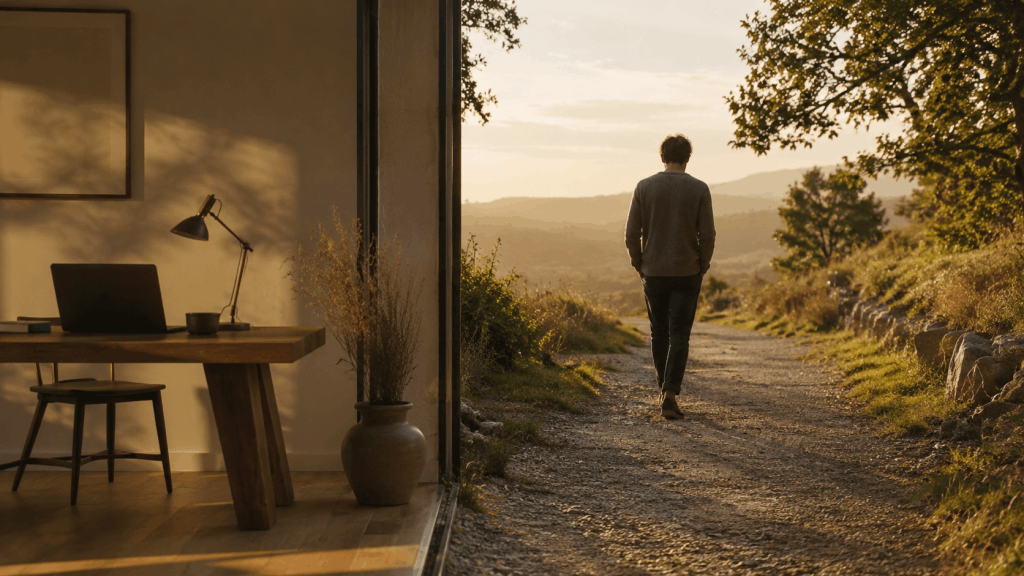
I’ll keep this practical, because philosophy without a Tuesday is just decoration.
A slow-productivity Tuesday with AI isn’t empty. It might be intense. But it has shape. A small number of real priorities instead of a scrolling list. The repetitive machinery running itself in the background. The communication batched, not constant. One genuinely hard, valuable thing done with full attention, instead of forty shallow ones done while half-distracted. And — this is the part that feels almost transgressive — a hard stop, with the afternoon belonging to your life rather than to the next available task.
The tools made all of this easier than it has ever been. We just have to choose to use them to make space, not to fill it.
The takeaway
AI hands you a lever. The lever doesn’t care which direction you push it. You can use it to produce more, faster, until you’ve automated yourself into a busier, noisier, more fragile version of the life you were trying to escape. Or you can use it to do less of what doesn’t matter, so you can do the few things that do with your whole attention — and keep the rest of your hours for living.
The machine got faster. That was never the question. The question is whether you’ll let it buy you a slower life, or sell you a louder one.
This is the practical engine behind the whole project — if you haven’t read why it exists, start with Why Enso Project Exists.


Rispondi